Have a question about the Grants Program? Responses to frequently asked questions are organized by topic area here and will be updated as needed. If your question isn’t answered here, send it to the Grants Program Manager at grants@parkscalifornia.org.
Important Dates
- February 18 – March 19, 2025: Letter of Intent Application Open Period
- February 26 to March 12, 2025: Community and One-on-One Office Hours
- Parks California provides assistance with questions, proposal development, and offers technical application support to all interested parties. Staff will be available during community office hours
- Join our Community Office Hours to get your grant questions answered in an open forum alongside other applicants. Each session can host up to 25 participants, creating a space to learn from each other while receiving focused support. Sessions will be regionally themed, but you’re welcome to join any date that works for you. Keep in mind that discussions may center on regional questions
- Regional Focus Dates:
- 📅 2/27 at 3 PM – Northern regions (North Coast, Sierra Nevada, Sacramento Valley)
- 📅 3/5 at 2 PM – Central regions (Sacramento Valley, San Joaquin Valley)
- 📅 3/6 at 3 PM – Eastern regions (Sierra Nevada, San Joaquin Valley)
- 📅 3/10 at 10 AM – Inland Deserts
- 📅 3/12 at 2 PM – West Coast applicants
- Regional Focus Dates:
- Sign up for a 1:1 Virtual Office Hour for a dedicated 15-minute session with the program manager to ask hyper-focused questions in real time. These sessions are designed as quick, drop-in opportunities to get direct support
- Limit: One session per organization
- March 19, 2025: Letter of Intent applications are due by 5:00pm
- March 18 to May 9, 2025: Review period for Letter of Intent applications
- May 12 to May 16, 2025: Selected Letter of Intent applicants will be invited to the full application stage
- May 19 to June 13, 2025: Invitees prepare their full application
- May 20 to June 11, 2025: Community and One-on-One Office Hours
- Parks California assists with questions, and proposal development, and offers technical application support to all interested parties. Staff will be available during community office hours
- June 13, 2025: Full applications are due by 5:00pm
- June 16 to July 11, 2025: Full application review period
- September 2025: Grant award notifications
- October 2025: Grant announcements and grant period begins
General Questions
Who can apply for this grant opportunity?
Eligible applicants include 501(c)3 organizations, California Native American Tribes, Native 7871 Organizations, Land Trusts, Fiscally Sponsored Community Organizations, Foundations, and/or Local Government Agencies (City, County, Regional).
For additional information, review the Minimum Eligibility Requirements.
If I am an artist, how can I get involved?
We encourage artists to sign up to our Artist Directory and reach out to eligible applicants (see question above) to get involved.
What are the different funding opportunities?
- Planning & Development Grants (8-month grant cycle; October 2025 – May 2026) support the early stages of project development with a focus on building partnerships, artist selection and developing project plans.
- Implementation Grants (12-month grant cycle; October 2025 – September 2026) support the execution of a community engagement, art and culture programs with a well-defined partnership.
Will there be other funding cycles for the Arts in California Parks Grants Program?
We anticipate launching the next cycle of the Arts in California Parks Grants Program in Spring 2026.
When should projects and activities take place?
- For the Planning & Development Grant, projects should take place within the 8-month grant period. Grant awards will be announced in October 2025, with projects to begin as early as October 2025 and should be completed by May 2026.
- For the Implementation Grant, projects should take place within the 12-month grant period. Grant awards will be announced in October 2025, with projects to begin as early as October 2025 and should be completed by September 2026.
What is the required coordination between entities within a grant application?
Please see the Partnership Model visual for further assistance.
For artist selection, the process depends on your approach. Some organizations already have relationships with artists, while others may conduct an open selection process. Applicants can also use the Arts in California Parks Artist Directory to find potential collaborators.
If invited to submit a full application, applicants must provide proof of the partnership, such as emails or signed letters from the organizations involved.
- For Planning & Development Grants we require that organizations engage with the relevant stakeholders to discuss their proposed activities before applying. Applicants must provide the name, title, and email address of the partnered entity. If available, supporting documentation of the proposed collaboration, such as emails or letters, is encouraged.
- For organizations, please specify your knowledge and awareness of government processes and procedures related to your grant proposal.
- For local parks, please specify if you have engaged with artists, nonprofits, or other community organizations.
- Implementation Grant applicants are required to provide evidence of confirmation that their organization has received approval with relevant stakeholders for the proposed activities before applying. Supporting documentation, such as emails or letters, confirming the established partnership will be due with your submission.
Do my projects and activities need to take place only in local public parks?
Yes, the Arts in California Parks Grants Program specifically will only fund projects that take place in local public parks.
How does Arts in California Parks define "local parks"?
The Arts in California Parks Grants Program intends to foster community connections to California’s diverse cultural history and natural areas beyond state park boundaries. Eligible projects will help enhance connections to local cultural history, local parks, open space or natural areas through community events, programming or installations that help to build sustainable community connections, health and well-being.
Eligible projects must be open to the general public. Projects may be located on land that is owned or managed by a local city, county, park or community service district, land trusts, regional park or open space district, non-profit organization or foundation, or any other entity other than federal and state agencies. Both indoor and outdoor spaces can be considered.
What is an “open space”?
An “open space” refers to a natural area accessible to the public, which may include natural conservancies, archaeological sites, and lands managed by nonprofit organizations. These spaces are characterized by their availability and accessibility, often not enclosed by fencing, and may have designated hours for public access.
What's an example of eligible indoor space?
In communities with limited parks and park amenities, museums, visitor centers, recreation centers, and theaters with indoor and outdoor spaces can emerge as alternatives. These facilities should be instrumental in providing access to communal gatherings, educational opportunities, and activities that enhance health and well-being, particularly where suitable outdoor environments are absent.
How does the Grant Program ensure equitable geographic distribution of grants?
To support a statewide approach, proposals will be ranked within their region as shown on the 2025/26 Grants Program Regional Map. A minimum of two projects will be funded per region.
Which regions will receive focused support?
Arts in California Parks is a statewide effort committed to equitable funding distribution. Based on past cycles, regions with fewer applications and grantees have been identified, and will provide focused outreach and support to increase participation. As shown on the 2025/26 Grants Program Regional Map, these regions are North Coast, Sierra Nevada, Sacramento Valley, San Joaquin Valley, Central Coast, Inland Desert, and California Native American tribes’ ancestral lands. While projects from all regions are encouraged to apply, focused support to these regions will help ensure historically underrepresented communities have greater access to funding opportunities.
How does the Grants Program support California State Parks’ Reexamining Our Past initiative?
Through the Arts in California Parks Grants Program, California State Parks and its partners aim to support California Native American tribes, artists, and communities in creating artwork that offers perspective on our past and present and helps us imagine our potential.
Where can I find the proposal scoresheets?
Scoresheets are available as PDFs as outlined below and via the Grants Program Resource Hub.
- Letter of Intent (LOI) Scoresheets
- Full Application Scoresheets
Who can I reach out to if I have questions about the grant guidelines?
- We encourage applicants to attend the Informational Webinar on February 25, 2025 for an overview of the grant guidelines.
- Parks California is available to answer questions, provide proposal support, and offer technical assistance.
- 📅 Mark your calendar for important dates!
- For additional questions, email us at grants@parkscalifornia.org
Can a single organization apply for multiple projects?
Only one application per organization will be considered for funding.
To apply for the Implementation Grant, do I need to have completed a Planning & Development Grant?
No, completing a Planning & Development Grant is not a requirement for Implementation Grant applicants.
Do I have to apply for an Implementation Grant after I complete my Planning & Development Grant?
We highly encourage Planning & Development Grant recipients to apply for the Implementation Grant. However, we understand that unexpected findings may require further planning by organizations and partners.
What are the partnership requirements for this grant?
- 501(c)3 organizations
- California Native American Tribes
- Native 7871 Organizations
- Land Trusts
- Fiscally Sponsored Community Organizations
- Community Foundations
- Government Agencies (excluding California State Parks and Federal Lands)
How many grants will be awarded?
The exact number of awards depends on available funding and the number of competitive applications received. Based on anticipated budget requests ($50,000 for Planning & Development and $100,000 for Implementation), we estimate awarding around 35 grants this cycle, with approximately $2.6 million in available funding.
Where can I find a list of eligible parks?
- Open to the general public
- Located on land owned or managed by local cities, county parks, community service districts, land trusts, regional park districts, nonprofits, or similar entities (excluding federal and state agencies).
If we receive a Planning & Development grant, will we get priority for an Implementation grant the following year?
Letter of Intent Questions
Why was a Letter of Intent application added to the Grant Program?
The Letter of Intent (LOI) application was introduced based on recommendations from applicants during feedback conversations and input from our Advisory Committee. This phase helps streamline the application process, reduce the initial burden on applicants, and ensure that only the most eligible and competitive projects advance to the Full Application stage.
What is a Letter of Intent?
A Letter of Intent (LOI) is a brief application that outlines your project’s key elements, such as goals, community engagement strategies, and budget. It helps determine if your project aligns with Program priorities before proceeding to a full application.
How do I submit a Letter of Intent?
Log into Foundant (Parks California Grantmaking Portal), complete the Eligibility Questionnaire, and fill out the appropriate Letter of Intent Application with the requested information during the open application period, February 18-March 19.
How do I know what to prepare before submitting a Letter of Intent?
Before submitting your LOI Application, review the Before You Start Checklist to ensure you have all the checklist items ready. Applicants must first complete the Eligibility Questionnaire to confirm they meet the minimum qualifications before accessing the LOI application.
How will a Letter of Intent be reviewed?
Please see our Planning & Development and Implementation Scoresheets PDFs as outlined below which are also available via the Grants Program Resource Hub.
- Letter of Intent (LOI) Scoresheets
- Full Application Scoresheets
Do I need to submit a completed project plan with a Letter of Intent?
No, the LOI focuses on the broad concept of your project. A detailed project plan is only required if you are invited to submit a full application.
What happens after the Letter of Intent application?
Applicants whose LOIs are selected by our Proposal Review Committee will be invited to submit a full proposal. While many factors are considered, we anticipate advancing 50 LOI applicants to the full application phase.
Will I receive feedback on my Letter of Intent if not selected?
Parks California will provide feedback upon request to help applicants refine their ideas for future cycles.
Does submitting an Letter of Intent guarantee an invitation to submit a full application?
No, LOI selection is competitive. Approximately 50 applicants will be invited to submit a full application based on Program goals and criteria alignment.
Programming Questions
What are the minimum eligibility requirements for the Arts in California Parks Grants Program’s project proposals?
Minimum Eligibility Requirements for the two grant tracks can be found here.
What are examples of art programs that qualify for Arts in California Parks?
The Arts in California Parks Grants Program welcomes various art programs, including, but not limited to, experiential, performance, temporary, and permanent installations, provided they incorporate a community engagement aspect to ensure relevance.
What are examples of community engagement?
Community engagement varies depending on the type of program and can take many forms. Examples include workshops or interviews to gather local insights, public meetings to seek input and feedback, and collaborative art projects that reflect the community’s identity. Other approaches may involve educational programs that raise awareness of relevant issues or hands-on activities that invite community members to participate directly in project planning. These are just a few ways to engage the community—applicants are encouraged to design engagement strategies that best align with their project goals and audience. The goal is to foster meaningful connections, ensure projects reflect community needs, and strengthen local involvement.
Is there a minimum set of hours of community engagement that we must conduct for this Grants Program?
We understand that each art program is unique and will have a varied schedule. While we don’t have a directive on hours, we ask you, the expert, to provide us with the best community engagement plan to inform your program.
Does Arts in California Parks have an artist directory I could reference for my program?
California State Parks invites artists that are interested in creating public art in California State and/or local parks to join the Arts in California Parks Artist Directory. The directory is a resource available to all State and local California Parks staff, as well as the general public, to be used to search for artists based on location, art medium, or other considerations, in order to explore opportunities for collaboration.
Does the application review process consider population size when evaluating "scale of impact"?
No, we do not prioritize projects based on population size. Instead, we assess impact relative to the community served and how well the project engages its intended audience.
Does this grant program have preferences and/or priorities towards program types (e.g. brand-new experiences vs previously implemented events, or installations vs events)?
No, there’s no preference between new or existing projects, and we don’t prioritize installations over events. What matters most is how well your project aligns with the program’s goals. Whether it’s a fresh concept or a continuation of a successful program, the key is its impact and connection to the community.
Budget and Allowable Cost Questions
Is this a reimbursement grant?
This is not a reimbursement grant. Funds are disbursed once the grant agreement is signed.
What are the allowable expenses under this grant?
We strongly encourage applicants to use the budget narrative within your Planning & Development Grant Budget Template (Excel file will download automatically) or your Implementation Grant Budget Template (Excel file will download automatically) to explain how each expense supports their project. Providing detailed explanations will help reviewers understand the connection between your budget requests and your project’s objectives, ensuring a clear justification for the requested funds.
- Planning & Development Grants allowable Program expenses could include but are not limited to costs associated with workshops, community engagement activities, staff time, planning, materials, and other forms of equitable artist selection practices.
- Implementation Grant allowable Program activities expenses could include but are not limited to costs associated with events, community engagements activities, artist fees, staff time, installations, exhibitions, rentals, permits, maintenance cost during the grant period and art program production.
What are considered ineligible costs under this grant?
Fundraising, grant writing, lobbying, costs outside grant performance period and costs outside the approved grant scope. Costs outside the approved grant period including long-term maintenance fees on temporary and permanent art.
Are indirect expenses allowed in this grant?
Indirect expenses are allowed as part of your grant proposal. These costs should be clearly detailed in both the budget and its budget narrative to ensure a full understanding of how these funds will support your project.
- Colleges, Universities, and Government agencies: For maximum efficiency of limited resources, it is Parks California’s policy to fund indirect or overhead costs up to 15% of the approved project amount.
- For Non-profit organizations, Parks California does not employ a fixed minimum or maximum rate for indirect costs.
- We highly encourage applicants to use the budget narrative to thoroughly explain any indirect cost requests. Clearly outlining the rationale for these expenses will help reviewers understand how they support your project’s goals and align with the overall funding request.
Do artists get paid for this type of work?
Artists should be compensated for their work. Artists’ fees will vary based on their scope. Please visit the Helpful Links and preview the Budget Templates below.
- Planning & Development Grant Budget Template (Excel file will download automatically)
- Implementation Grant Budget Template (Excel file will download automatically)
What is the best way to estimate artist fees?
Artist fees are an allowable expense, and artists should be compensated for their time and talents. To inform your budget proposal, discuss the scope of your project with the artist (or art-based organization). You can find additional resources here.
Is my organization allowed to charge a fee for members of the public to participate in the art program proposed in the application?
All art experiences associated with this Grants Program should be free and accessible to members of the public.
Can grant funds be used for the maintenance of art installations?
Funds from the Arts in California Parks Grants Program are designated for the creation and implementation of art programs and cannot be allocated towards the long-term maintenance of temporary to permanent art installations. Applicants who will need maintenance for their temporary or permanent installations should outline a clear strategy for maintaining their art installations, including a detailed maintenance schedule, identification of alternative funding sources, and staffing plans.
Are there minimum or maximum grant request amounst for either grant track?
There are no strict minimum or maximum grant request amounts. However, based on 2024 applications and awarded projects, we anticipate:
- Planning & Development Grant requests around $50,000
- Implementation Grant requests around $100,000
These figures serve as a general reference, but applicants are encouraged to request the amount necessary to successfully complete their project.
What level of matching contributions is required to receive full points in the Implementation LOI?
There is no strict minimum requirement for matching montributions, but to receive the full 5 points in this bonus category, applicants should aim to secure matching funds equivalent to at least 40% of their total grant request. Matching contributions may include:
- Cash contributions from external funding sources
- In-kind support (such as donated materials, services, or volunteer time)
- Partnership commitments that contribute financial or material resources to the project.
Projects with matching funds between 20–39% may receive partial points, while those below 20% may receive fewer or no points in this category. The Proposal Review Committee will assess the scale, relevance, and impact of matching contributions in relation to the project’s scope and goals.
Is this funding considered a government grant?
Parks California, a nonprofit, administers this grant program. While this is not a government grant, grantees will be subject to grant terms outlined in Parks California’s agreement with California State Parks.
What does "Matching Grant Funds" mean in the budget form? Should I include only the grant request or the total project budget?
Matching funds refer to any additional financial or in-kind contributions that support your project. This can include:
- Additional funding from partners or other resources
- In-kind contributions, such as volunteer time or donated materials
- If your project has matching support, you can include this in your budget. Volunteer time can be counted as an in-kind contribution.
Matching contributions may include: cash contributions from external funding sources., In-kind support (such as donated materials, services, or volunteer time), partnership commitments that contribute financial or material resources to the project.
If we hire a consultant to assist with artist selection, where should that expense go in the budget?
Consultant fees should be listed under “Fees associated with artist selection processes” rather than “Salary and Benefits.” Since consultants are typically hired on a contractual basis rather than as staff, this ensures the expense is categorized correctly and reflects the temporary nature of their role in the project.
Reporting Requirements
What are the reporting requirements?
A mid-year and final report will be required of all grantees. Final reports are due within 30 days upon conclusion of the funded activity. Grantees shall use the report template provided by Parks California and all reports shall be submitted electronically through Foundant. In addition to the final report, Planning and Development grantees, will also be asked to submit a Final Project Plan.
In addition to grant reporting, what else will grantees be asked to provide?
Parks California wants to illuminate the great work happening across the state. We will ask grantees to share information such as photos, quotes, interviews, etc. to highlight the collective impact in local parks. These stories will be used for internal and external communications, reporting, and marketing materials. Through this Program, we also seek to capture case studies, exchange best practices, and identify statewide opportunities for accelerating and broadening access for a more diverse park workforce at all levels.
Proposal Review Process
How will proposals be reviewed?
The proposal review process consists of two phases: Letter of Intent (LOI) Review and Full Application Review.
- Letter of Intent Review: Applicants will first submit an Eligibility Questionnaire to confirm their organization meets all the minimum requirements to apply. Eligible applicants will then submit a Letter of Intent (LOI) to assess project fit. Using the LOI Scoresheet, the Proposal Review Committee will evaluate and rank LOIs within their regions to ensure statewide representation, with a minimum of two LOI applicants per region invited to submit a Full Application. After this region-based selection, the remaining LOI applications will be discussed and selected based on rankings from the Proposal Review Committee. Approximately 50 LOI applicants will be invited to submit a Full Application.
- Full Application Review: The Proposal Review Committee will score and rank submitted Full Applications. Using the Full Application Score Sheet, the Proposal Review Committee will evaluate and rank Full Applications within their regions to ensure statewide representation, with a minimum of two projects funded per region. After this region-based selection, the remaining Full Applications will be discussed and selected based on rankings from the Proposal Review Committee.
Review the scoring sheet for Planning & Development and Implementation applications here.
In the event my organization does not receive a grant, will Parks California provide feedback on our proposal?
Parks California will provide feedback to all interested parties and provide respective feedback related to their proposals.
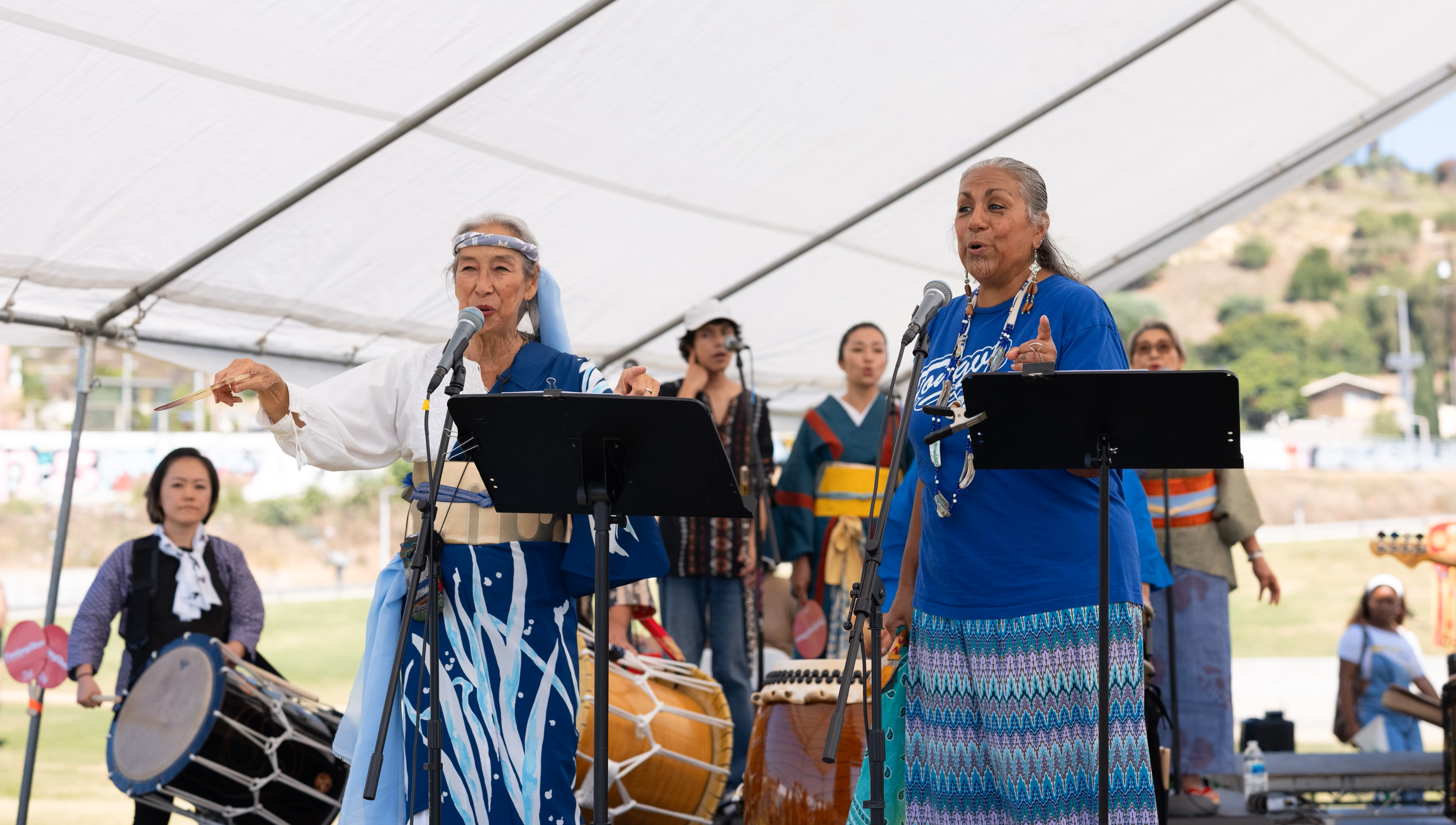
Little Tokyo’s Nobuko Miyamoto and Tina Calderon (Gabrielino Tongva, Chumash, Yoeme) engage attendees at the community event, Procession at Los Angeles State Historic Park on October 21, 2023. Photo by Meztli Projects.